
How Often Should You Follow Up on an HVAC Estimate? A Practical Follow-Up Schedule
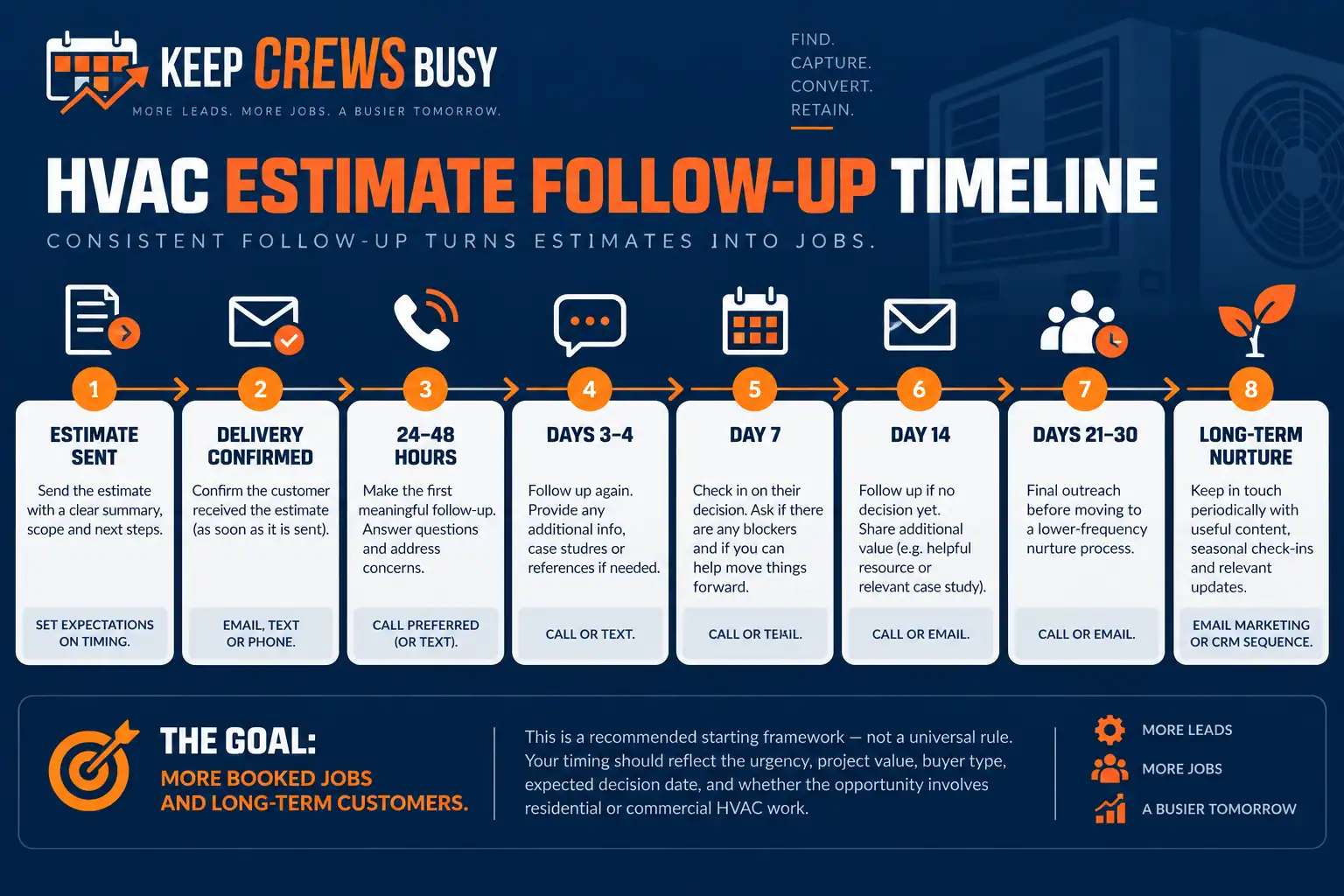
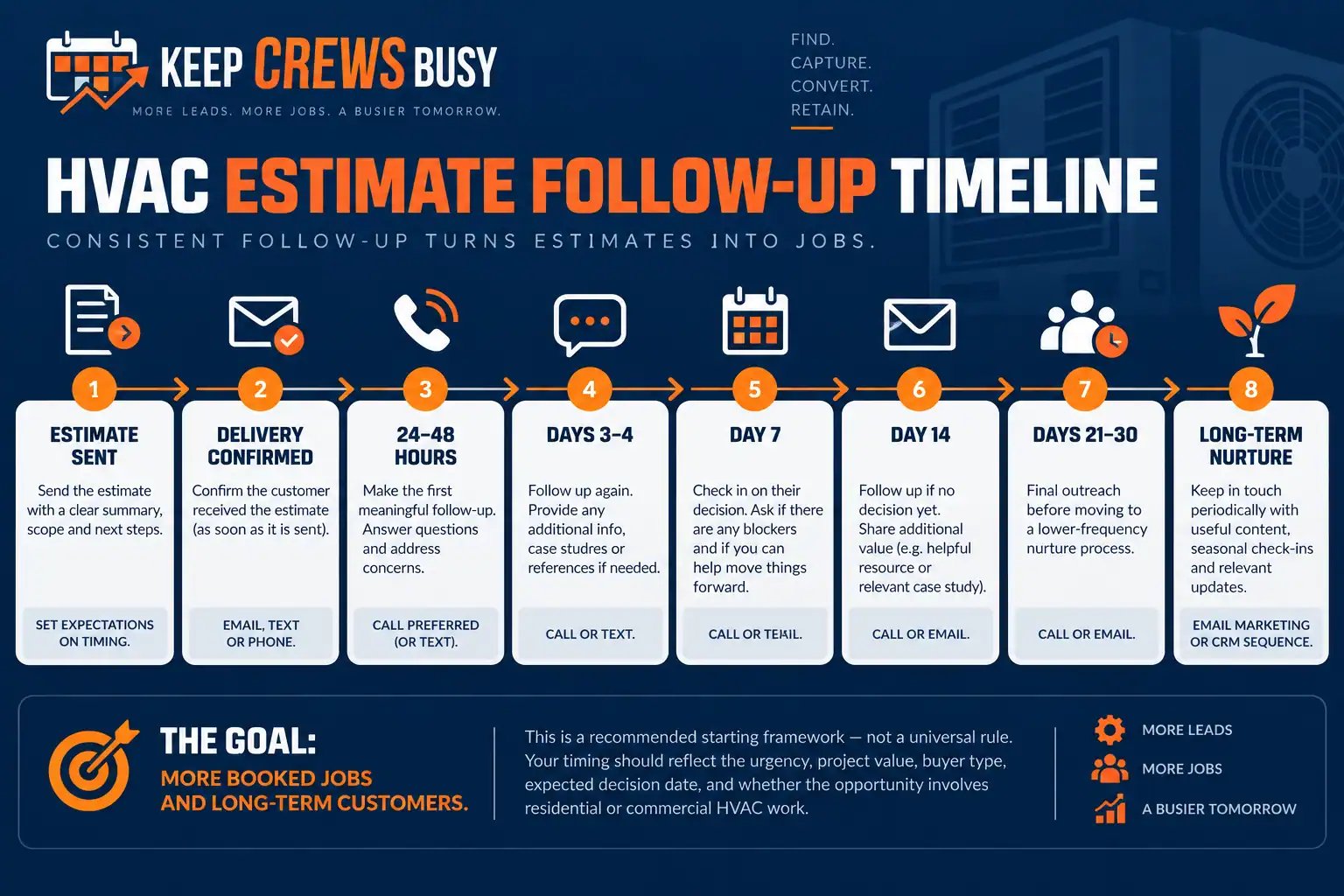
An HVAC company should confirm delivery immediately, make personal contact within 24–48 hours, follow up around days 3–4 and again on day 7, then move undecided opportunities into a lower-frequency nurture process.
This is a recommended starting framework—not a universal rule. Your timing should reflect the urgency, project value, buyer type, expected decision date, and whether the opportunity involves residential or commercial HVAC work.
Key Takeaways
- Confirm that the customer received the estimate as soon as it is sent.
- Make the first meaningful follow-up within 24–48 hours.
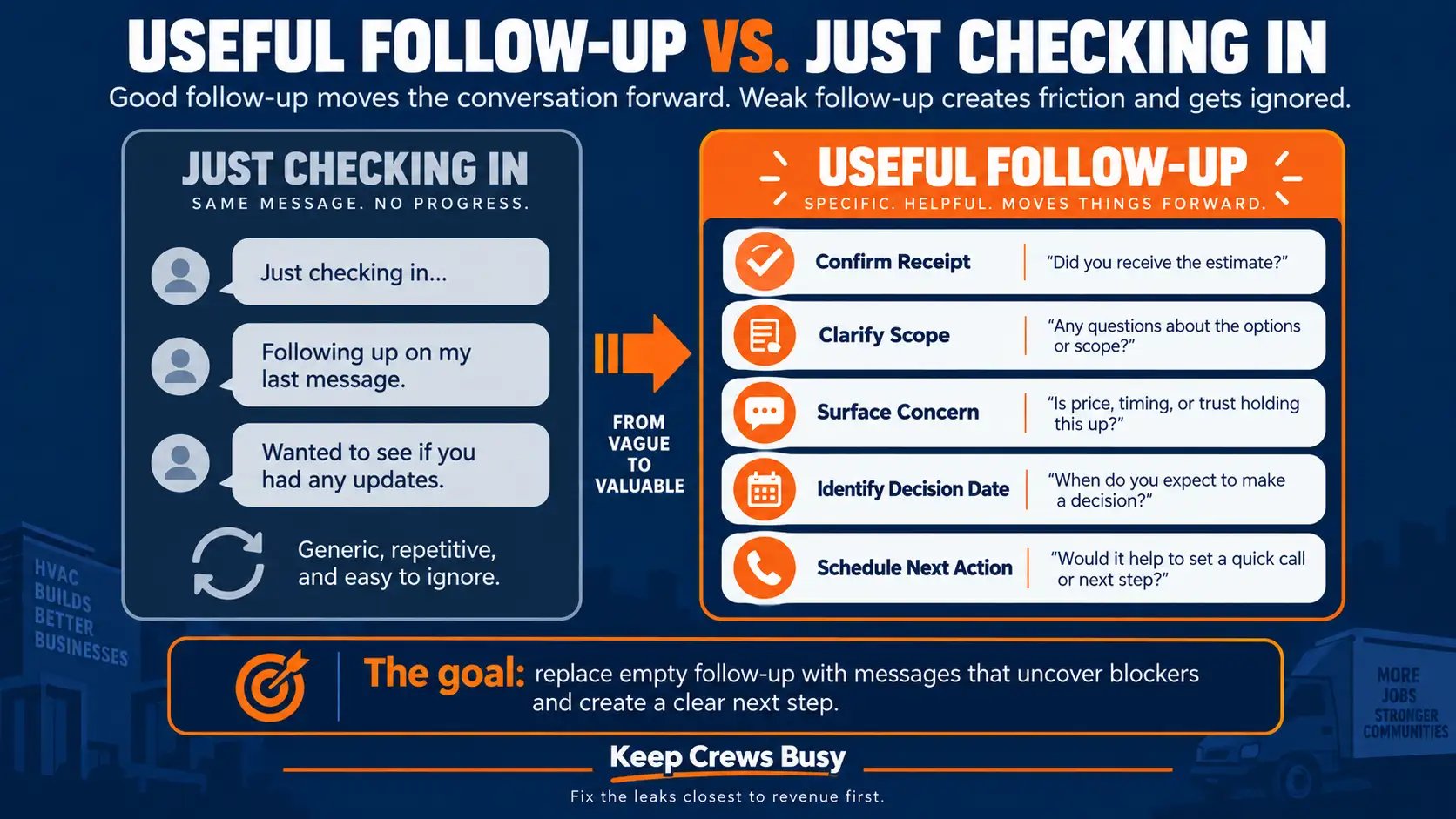
- Follow up with a specific purpose—not simply to “check in.”
- Commercial proposals may require a longer cycle, but every opportunity should still have a defined next step.
- Track the estimate through the decision so you can connect follow-up activity to booked revenue.
Recommended HVAC Estimate Follow-Up Schedule
The right HVAC estimate follow-up schedule depends on what the customer is buying and how the decision will be made. A failed compressor affecting an occupied building cannot be treated like a replacement system planned for the next budget year.
Use the following schedule as a starting point, then adjust it using the information collected during the sales process.
| Timing | Recommended channel | Purpose | Suggested next action |
|---|---|---|---|
| Immediately after sending | Email, followed by text when appropriate | Confirm delivery and provide a clear point of contact | Ask the customer to confirm receipt and offer a specific time to review the estimate |
| Within 24–48 hours | Phone call or personal email | Answer questions and confirm that the scope matches the customer’s needs | Schedule a review call, site visit, or decision checkpoint |
| Days 3–4 | Phone, email, or text based on customer preference | Surface concerns involving scope, price, timing, trust, financing, or approval | Resolve the concern or agree on the next action |
| Day 7 | Phone call followed by a concise email | Determine whether the opportunity is active, delayed, or changing | Confirm the expected decision date or move the opportunity to the proper pipeline stage |
| Day 14 | Email or phone | Revisit active opportunities without creating artificial pressure | Ask whether the customer needs a revision, additional documentation, or more time |
| Days 21–30 | Email or scheduled call | Close the loop on opportunities without a near-term decision | Agree to a future contact date, move to nurture, or mark the opportunity lost |
| Long-term nurture | Occasional email, scheduled task, or CRM workflow | Stay useful to customers whose projects are legitimate but delayed | Send relevant seasonal reminders, planning information, or a scheduled budget-cycle follow-up |
Do not follow the calendar mechanically. If the buyer tells you that bids will be reviewed on September 15, the next action should be based on that date—not an automated day-seven message that ignores the conversation.
Why HVAC Estimate Follow-Up Matters
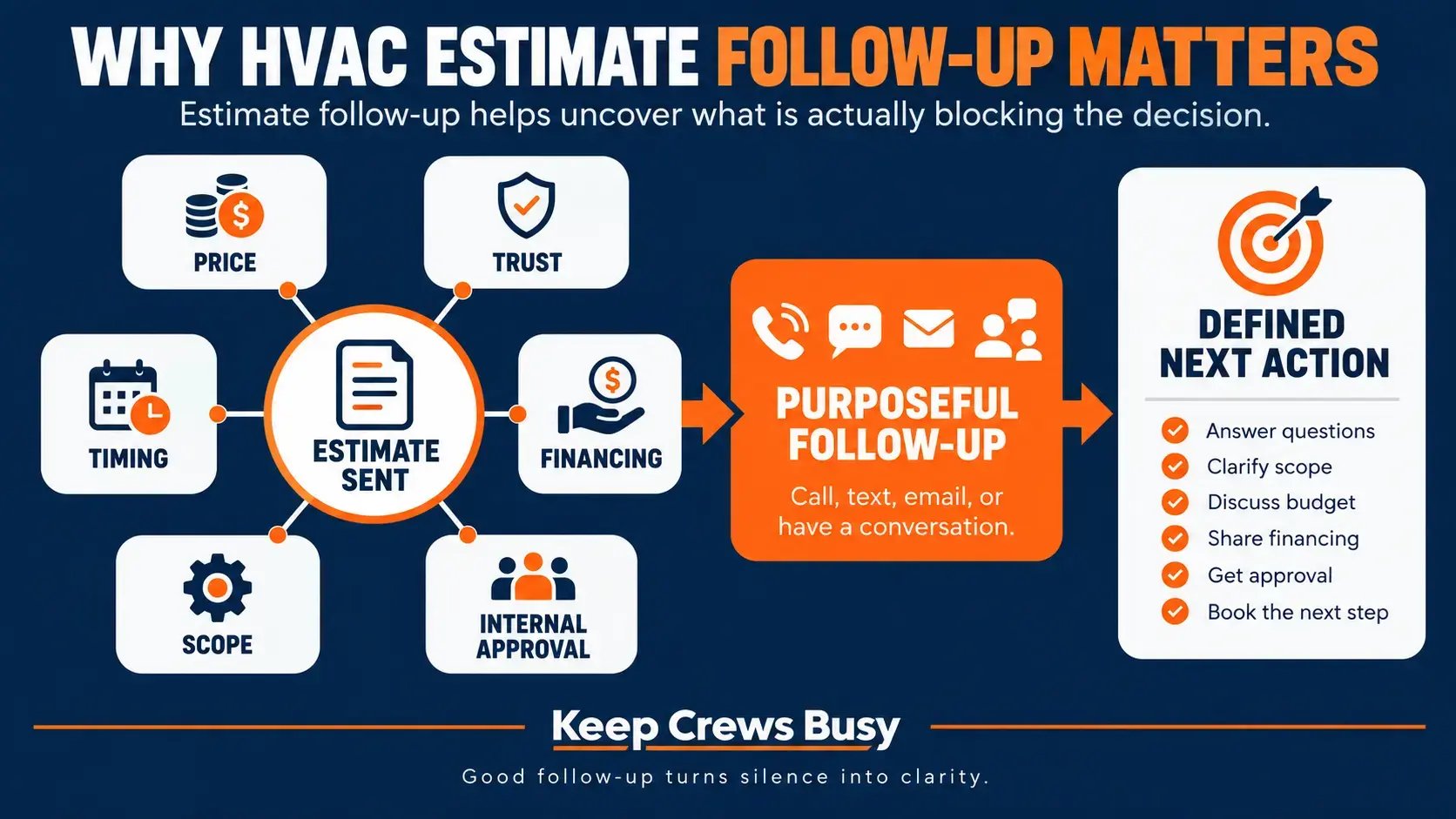
An estimate is not the end of the sales process. It is a transition point between diagnosing the customer’s needs and helping the customer make a decision.
After receiving an estimate, a buyer may still need to:
- Compare competing scopes
- Speak with a spouse, business partner, property manager, or executive
- Confirm available financing or budget
- Understand the differences between repair and replacement options
- Review equipment, warranty, scheduling, or maintenance details
- Obtain internal approval
- Ask for changes to the proposed scope
Without follow-up, the HVAC company may never learn which issue is preventing the decision. The estimate may remain open indefinitely, even though the customer has already selected a competitor, delayed the project, changed the scope, or decided not to proceed.
Consistent follow-up gives the company better operational visibility. It helps the sales and office teams distinguish genuine opportunities from delayed, disqualified, and lost work.
What Should Each Follow-Up Accomplish?
Every HVAC estimate follow-up should do at least one of the following:
- Confirm receipt
- Answer a question
- Clarify the scope
- Identify a decision-maker
- Determine the expected decision date
- Surface a price, trust, timing, financing, or approval concern
- Schedule a definite next action
- Record why the opportunity was won, lost, or delayed
“Good follow-up reduces uncertainty. Bad follow-up merely reminds the prospect that the salesperson wants an answer.”
Avoid sending the same “just checking in” message repeatedly. It creates work for the sales team without giving the buyer a meaningful reason to respond.
A better follow-up connects directly to the customer’s situation:
- “Did the proposed scope accurately reflect what you discussed with our technician?”
- “Who else will be involved in approving this project?”
- “Would it help to review the repair and replacement options together?”
- “You mentioned reviewing bids on Friday. Would Monday morning be a reasonable time to discuss the decision?”
- “Is the project still planned for this quarter, or has the expected timeline changed?”
The objective is not to pressure the buyer. It is to clarify what must happen next.
How Follow-Up Should Change by Type of HVAC Opportunity
Emergency HVAC Repairs
Emergency repair follow-up should move faster than the standard cadence because the buyer may need an immediate decision.
Confirm delivery as soon as the estimate is sent. When possible, call or text shortly afterward to make sure the customer understands the recommended repair, availability, and next step.
For an urgent service issue, waiting several days may make the follow-up irrelevant. The customer may have already selected another contractor because restoring heating, cooling, refrigeration, or ventilation could not wait.
The follow-up record should identify:
- Whether the equipment is currently operating
- How the failure affects the home or facility
- Whether temporary options are available
- Who can authorize the work
- When the customer expects to decide
- Whether the opportunity was won or lost
Residential System Replacements
A residential replacement often involves more consideration than an emergency repair. The homeowner may compare contractors, financing options, equipment tiers, warranties, rebates, and installation schedules.
Confirm delivery immediately and make personal contact within 24–48 hours. Use the conversation to determine what matters most to the homeowner rather than immediately offering a discount.
Useful questions include:
- Does the recommended system match what you expected?
- Are you comparing different equipment, different contractors, or both?
- Is financing part of the decision?
- Is there anything in the scope that needs clarification?
- When are you hoping to have the new system installed?
Follow up around days 3–4 and day 7 if the decision remains open. If the customer’s timeline is longer, agree on the next contact date instead of continuing frequent messages.
Commercial HVAC Proposals
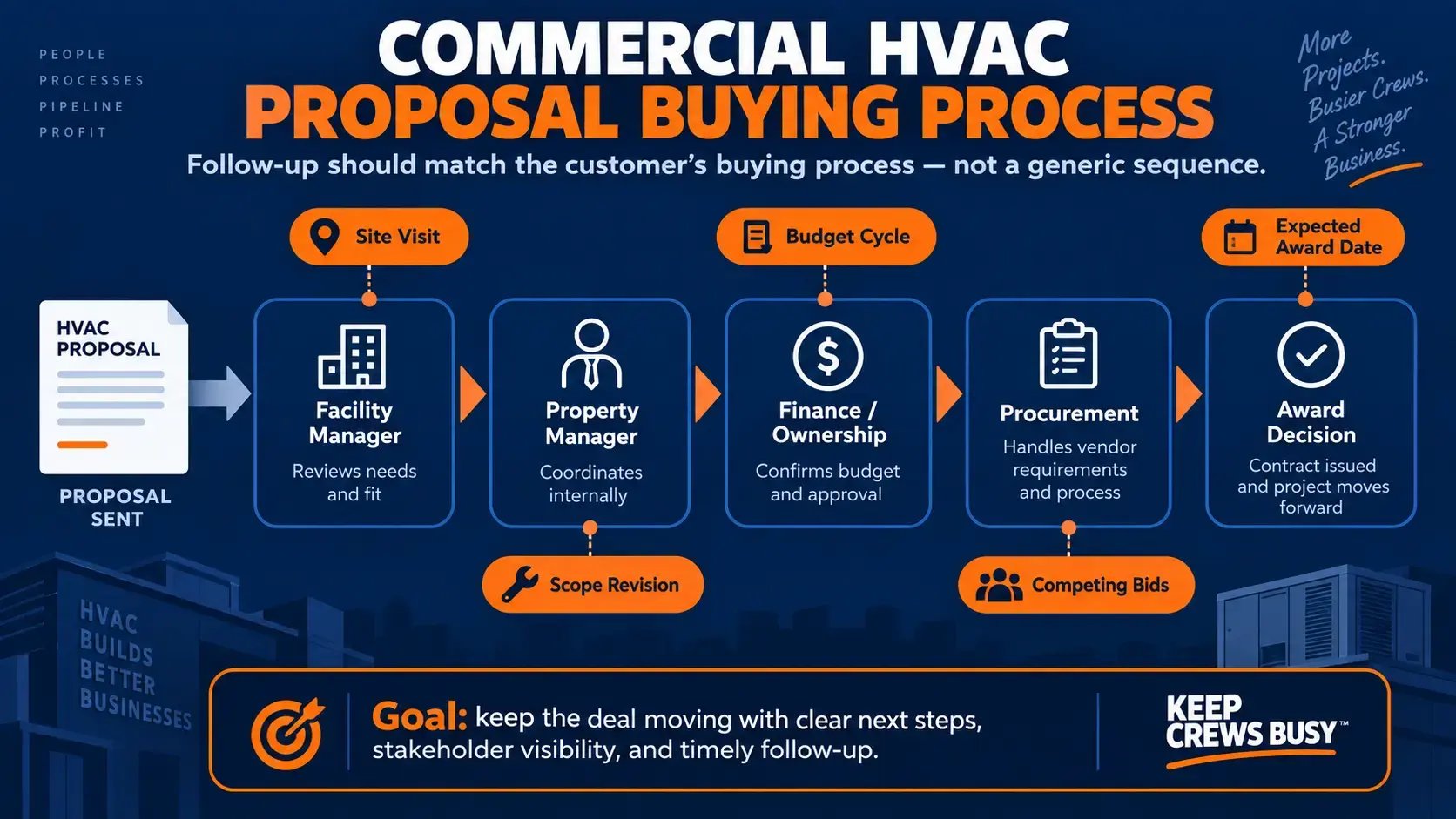
Commercial HVAC proposal follow-up should be built around the customer’s buying process rather than a generic sequence.
A commercial HVAC proposal may remain open longer than a residential estimate, but a longer sales cycle should not mean having no defined next step.
Before or immediately after sending the proposal, identify:
- Every decision-maker and stakeholder
- The person responsible for technical review
- The person with budget authority
- Procurement or vendor-registration requirements
- Whether competing bids are required
- Whether another site visit is needed
- Potential scope revisions or alternates
- The budget and approval cycle
- The expected award date
- The next scheduled conversation
For larger projects, ask whether the proposal must be presented to ownership, a facilities committee, property management, procurement, or another executive. If the contact cannot approve the project, determine how the proposal will reach the person who can.
Whenever possible, schedule a defined next step before ending the conversation. That could be a proposal review, site walk, engineering discussion, scope revision, procurement submission, or post-bid decision call.
Maintenance Agreements
Maintenance-agreement follow-up should focus on operational value, scope, and timing—not only price.
The buyer may need to compare:
- Equipment covered
- Inspection frequency
- Labor and material inclusions
- Reporting requirements
- Response priority
- Renewal terms
- Service exclusions
- Budget timing
A proposal may be delayed because an existing agreement has not expired or because the next operating budget has not been approved. Record that timing and schedule the follow-up accordingly.
If the renewal date is six months away, weekly follow-up is unlikely to help. A CRM task 60–90 days before the decision window may be more appropriate.
Editable HVAC Estimate Follow-Up Templates
Immediate Estimate-Delivery Confirmation
Subject: Your HVAC estimate from [Company Name]
Hi [First Name],
I’ve attached the estimate for [brief description of work]. Please let me know when you receive it.
I’m available to review the scope, answer questions, or discuss the next step. Would [day/time] be convenient for a brief review?
Thank you,
[Name]
[Company]
[Phone]
24–48-Hour Follow-Up
Hi [First Name],
I wanted to make sure the estimate for [project or service] came through and accurately reflects what we discussed.
What questions can I answer about the scope, equipment, schedule, or next step?
[Name]
[Company]
Residential Replacement Follow-Up
Hi [First Name],
As you review the replacement options, I wanted to see whether anything needs clarification—particularly the equipment, warranty, financing, or installation plan.
Are you comfortable with the recommended option, or would it help to compare the choices together?
[Name]
[Company]
Commercial HVAC Proposal Follow-Up
Subject: Next step for [Facility or Project Name]
Hi [First Name],
I’m following up on the proposal for [project]. Does the scope align with your operational and technical requirements?
You mentioned that [stakeholders or department] would also review it. Are there procurement requirements, scope questions, or revisions we should address before the expected decision date?
Would [specific date and time] work for a brief proposal review?
Best,
[Name]
[Company]
Follow-Up Addressing Uncertainty
Hi [First Name],
It sounds like the decision may still depend on [timing, scope, approval, budget, or another stated concern].
Would it be helpful if we [reviewed the scope, provided an alternate option, clarified a line item, or spoke with another decision-maker]? If the timing has changed, that is helpful for us to know too.
[Name]
[Company]
Polite Closing-the-Loop Message
Subject: Closing the loop on your HVAC estimate
Hi [First Name],
I haven’t been able to reach you, so I’ll pause active follow-up for now.
If the project is still under consideration, reply with your expected timing and I’ll follow up accordingly. If you selected another direction, any brief feedback would help us close our records accurately.
Thank you,
[Name]
[Company]
When Should You Stop or Pause Active Follow-Up?
Following up indefinitely makes the pipeline less trustworthy. Every estimate should eventually be classified based on its actual status.
Open Opportunity
Keep the estimate open when the buyer has a legitimate need, a realistic path to purchase, and a defined next step or decision date.
Long-Term Nurture
Move an opportunity to nurture when the project is legitimate but the timing is outside the active sales window. Record why it is delayed and when follow-up should resume.
Closed-Lost
Mark an estimate closed-lost when the customer selects another contractor, rejects the proposal, cancels the project, or confirms that the work will not proceed. Record the reason whenever possible.
Unresponsive
Use an unresponsive status when the prospect has not replied after a reasonable sequence of calls, emails, or texts. Send a polite closing-the-loop message before pausing active outreach.
Disqualified
Disqualify opportunities that are outside your service area, outside your capabilities, financially unrealistic, fraudulent, or otherwise not a fit.
Honor opt-out requests and follow applicable communication and privacy laws. Companies should obtain appropriate legal advice for their specific texting, calling, email, consent, and recordkeeping practices.
A Lightweight HVAC Estimate Pipeline
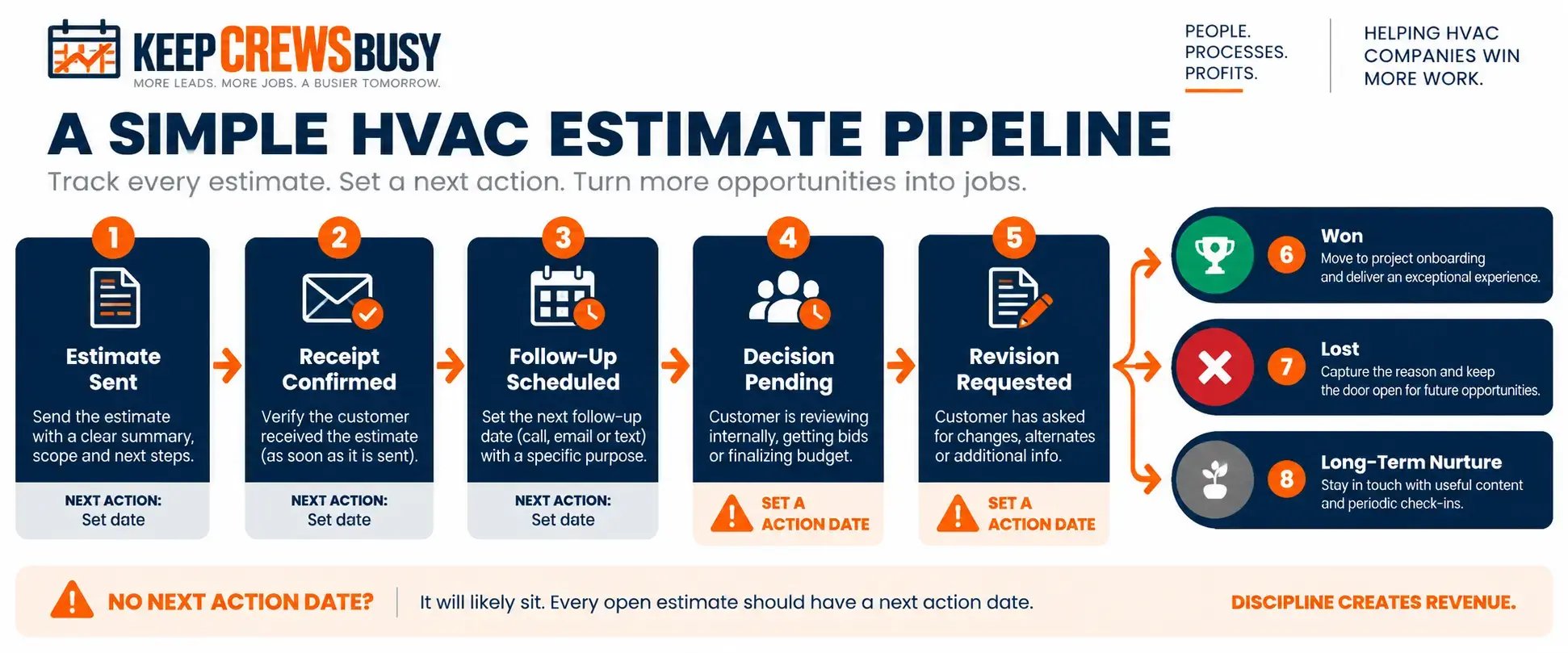
A useful pipeline does not need dozens of stages. It needs enough structure to show what happened after each estimate was sent.
Use these stages:
- Estimate sent
- Receipt confirmed
- Follow-up scheduled
- Decision pending
- Revision requested
- Won
- Lost
- Long-term nurture
For each opportunity, track:
- Estimate value
- Project or service type
- Date sent
- Decision-maker
- Expected decision date
- Next action
- Next-action date
- Primary objection
- Won or lost reason
- Revenue won
The most important rule is simple: an open opportunity should have a next action and a next-action date. If neither exists, the opportunity is likely sitting in the pipeline without active ownership.
HVAC Estimate Follow-Up Metrics to Track
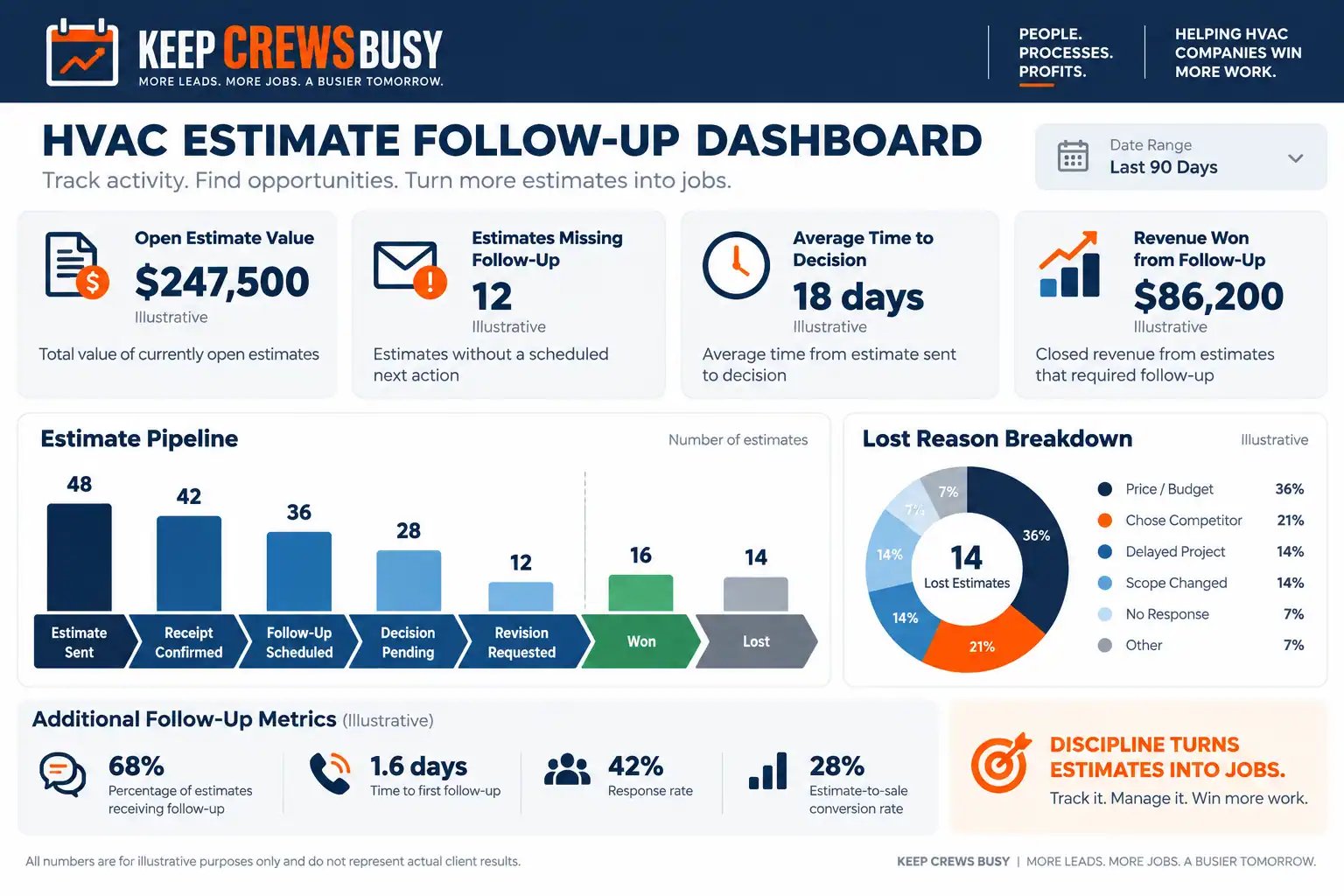
Tracking follow-up activity helps an HVAC company see whether estimates are being managed consistently and what happens after they are delivered.
Useful metrics include:
- Estimates sent
- Percentage of estimates receiving follow-up
- Time to first follow-up
- Response rate
- Estimate-to-sale conversion rate
- Revenue won from followed-up estimates
- Average time to a decision
- Total value of open estimates
- Lost reasons
- Opportunities without a scheduled next action
Estimate-to-sale conversion rate can be calculated as:
Number of won estimates ÷ total qualified estimates sent × 100
Define the metric consistently. For example, decide how cancellations, duplicate estimates, unqualified inquiries, and alternative proposal options will be treated.
Start by comparing results against your company’s own historical baseline. Seasonality, job type, lead source, market conditions, service area, and price point can all affect performance. A residential replacement team and a commercial project division should not automatically be judged against the same benchmark.
The goal is not to create an impressive-looking dashboard. It is to identify where legitimate opportunities stop moving and whether the company can connect estimates to actual booked work.
Common HVAC Estimate Follow-Up Mistakes
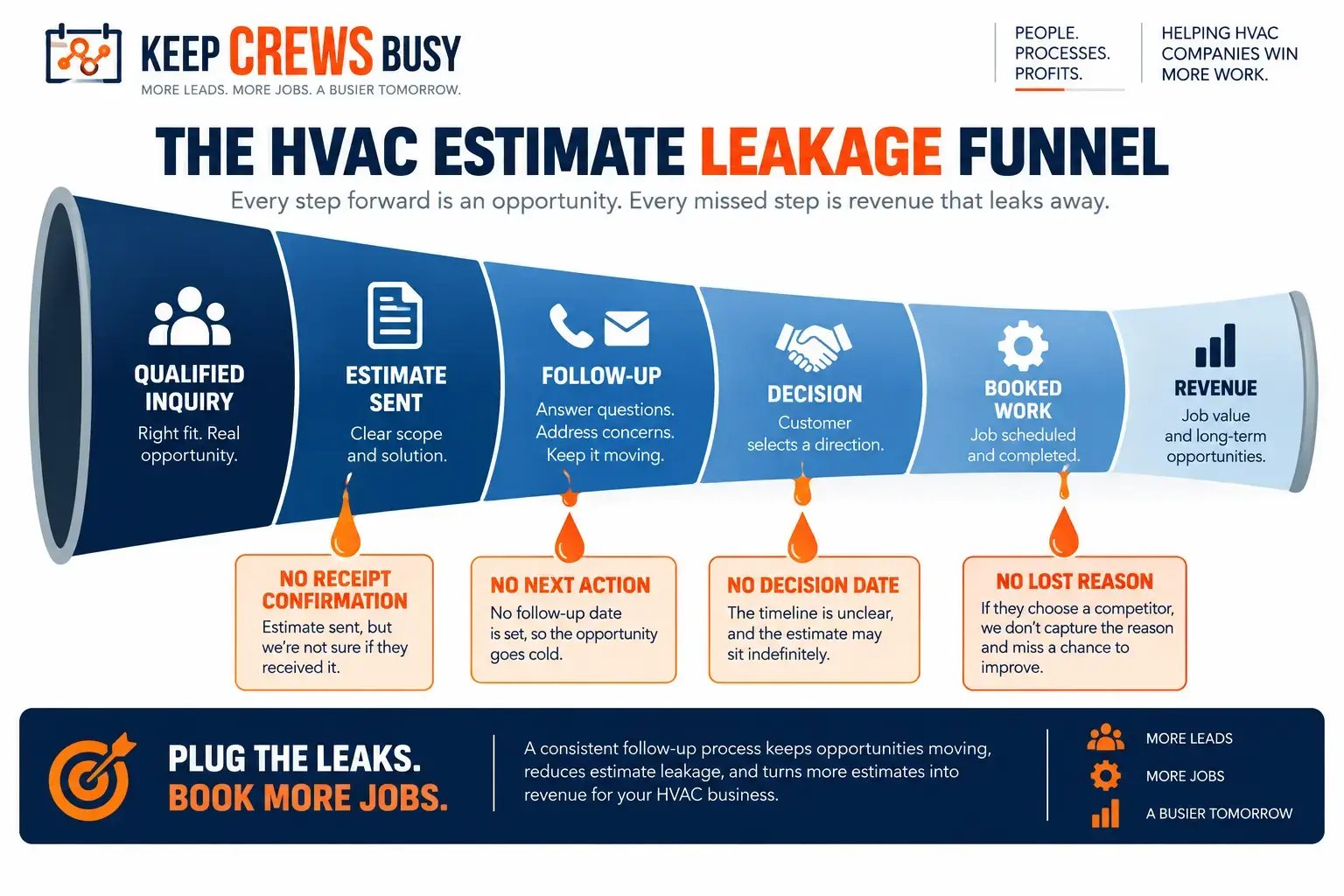
Waiting Too Long
A delayed first follow-up can leave the buyer without answers during the most active part of the decision. Confirm delivery immediately and make meaningful contact within 24–48 hours unless the customer specifies another schedule.
Repeating “Just Checking In”
Every message should reduce uncertainty or advance the decision. Repeated reminders without context give the buyer little reason to respond.
Treating Commercial and Residential Opportunities the Same
Commercial projects may involve multiple decision-makers, procurement rules, site visits, competing bids, and longer approval cycles. The follow-up process should reflect those realities.
Failing to Establish a Decision Date
Without an expected decision date, the salesperson cannot distinguish an active opportunity from an indefinitely delayed estimate.
Automating Messages Without Monitoring Replies
Automation can create reminders and send basic confirmations, but someone must monitor responses, update the CRM, and take ownership when a buyer asks a question.
Discounting Before Identifying the Actual Objection
Price may not be the real issue. The customer may be uncertain about scope, trust, financing, timing, equipment, or internal approval. Diagnose the concern before changing the price.
Leaving Estimates Open Indefinitely
Old estimates inflate the pipeline and obscure what is realistically available to close. Move inactive opportunities into nurture, lost, unresponsive, or disqualified stages.
Tracking Estimates Without Connecting Them to Revenue
Counting proposals is a leading indicator. The business outcome is whether qualified opportunities become booked and completed work that produces revenue.
Failing to Record Lost Reasons
Lost reasons help management identify patterns involving price, response time, service area, financing, competition, scope, trust, and sales execution. Without those records, future decisions are based on anecdotes.
Frequently Asked Questions
How soon should an HVAC company follow up after sending an estimate?
Confirm delivery immediately and make personal contact within 24–48 hours. Emergency repairs may require follow-up within minutes or hours, while commercial proposals should follow the customer’s stated review and approval schedule. The objective of the first contact is to confirm receipt, clarify the scope, and establish the next action.
How many times should you follow up on an HVAC estimate?
A practical starting sequence includes immediate confirmation, personal follow-up within 24–48 hours, and additional contact around days 3–4, 7, and 14. After that, either establish a customer-specific next step, move the opportunity into nurture, or close it appropriately. Do not continue contacting buyers indefinitely without a reason.
Should HVAC follow-up happen by phone, text, or email?
Use the channel that fits the customer, urgency, and complexity of the decision. Email works well for documents and detailed commercial communication. Phone calls help uncover concerns. Text can confirm receipt or coordinate timing when the customer has agreed to use it. Important decisions and next steps should be recorded in the CRM.
How do you follow up without sounding pushy?
Make every follow-up useful. Ask whether the scope is accurate, answer a relevant question, clarify the decision process, or schedule a specific next step. Reference what the buyer previously shared. Avoid artificial urgency, repeated “just checking in” messages, unnecessary discounts, or language designed to pressure the customer.
How long should an HVAC estimate remain open?
An estimate should remain open while there is a legitimate opportunity and a defined next action. The appropriate period depends on the project, pricing validity, equipment availability, and buying cycle. If the decision is delayed, move it into nurture. If the customer declines, chooses another contractor, or becomes unresponsive, update the status.
How is commercial HVAC proposal follow-up different?
Commercial proposals often involve multiple stakeholders, procurement requirements, competing bids, budget cycles, site visits, and scope revisions. Follow-up should identify who approves the work, how the proposal will be evaluated, when a decision is expected, and what must happen next. Longer sales cycles still require clear ownership and scheduled actions.
Can HVAC estimate follow-up be automated?
Parts of the process can be automated, including delivery confirmations, reminders, task creation, and basic nurture messages. Automation should not replace personal conversations for complex, urgent, or high-value work. Someone must monitor replies, answer questions, update opportunity stages, and prevent inappropriate messages from continuing after a decision or opt-out.
What should an HVAC company track after sending an estimate?
Track the estimate value, service or project type, date sent, decision-maker, expected decision date, next action, next-action date, primary objection, current status, and won or lost reason. When the work is won, connect the opportunity to booked and completed revenue so management can evaluate the entire sales path.
Turn HVAC Estimate Follow-Up Into Revenue Visibility
A practical HVAC estimate follow-up schedule begins with immediate delivery confirmation, personal contact within 24–48 hours, follow-ups around days 3–4 and day 7, and an intentional decision at day 14 or later to continue, nurture, or close the opportunity.
The schedule creates consistency, but the conversation determines the timing. Urgency, project value, customer type, buying process, and expected decision date should always shape the next action.
If your company sends plenty of estimates but cannot consistently see what happens afterward, the problem may be less about lead generation and more about the path between inquiry, estimate, follow-up, and booked revenue.
Keep Crews Busy’s Commercial HVAC Revenue Leak Audit is designed to examine that path—from visibility and lead capture through follow-up, sales tracking, and revenue attribution. If you want a clearer view of where opportunities may be getting delayed or lost, you can request an audit from Keep Crews Busy.