Quick Answer: "Track HVAC marketing ROI by assigning every call and form to a source, recording whether the inquiry is qualified, and carrying that source through the estimate, booked-job, revenue, and maintenance stages. Compare channels by cost per qualified opportunity, cost per booked job, gross profit, and long-term customer value—not lead volume alone."
Reliable attribution begins with HVAC call tracking and marketing attribution, but phone numbers are only the first step. The real job is connecting the original source to what happened after the conversation.
A dashboard that shows clicks, rankings, and calls without estimates or booked work cannot answer the question an owner actually cares about: which marketing investment created profitable HVAC revenue?
Define ROI Before You Build the Report
Teams often use “ROI” to describe different numbers. Agree on the calculation and the costs included. Revenue return can be useful for a quick channel comparison. Gross-profit return is more useful when job types have different margins. Full marketing ROI may include media, agency or staff costs, software, creative work, and other direct expenses.
A simple formula is:
Marketing ROI = (Attributed gross profit − marketing cost) ÷ marketing cost
Use a consistent time window and explain whether the report uses invoiced revenue, collected revenue, booked revenue, or estimated opportunity value.
Track the Metrics Closest to Revenue
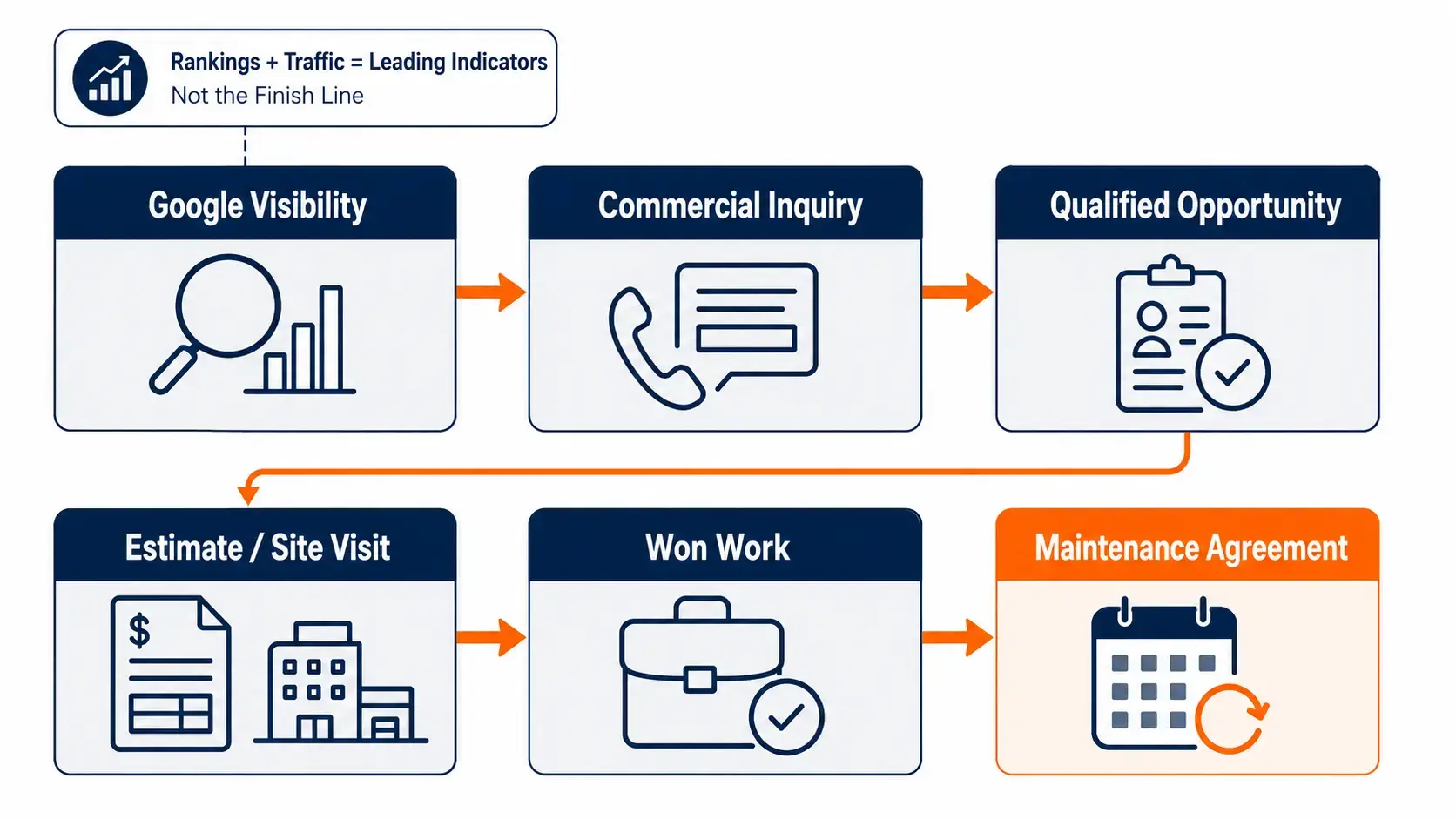
| Stage | Useful metric | Question answered |
|---|---|---|
| Visibility | Qualified impressions, rankings, ad reach | Are the right buyers seeing us? |
| Response | Calls, forms, chats | Are buyers taking action? |
| Qualification | Qualified lead rate | Do inquiries fit our services and market? |
| Sales | Site visits, estimates, open opportunities | Is the team advancing the lead? |
| Revenue | Booked jobs, gross profit, agreements | Did the channel create profitable work? |
Leading indicators help diagnose the path, but they are not the finish line. An increase in traffic is useful only when it leads to better commercial opportunities or supports a clear strategic goal.
Create a Consistent Source Taxonomy
Use a short list of source categories that everyone understands: organic search, Google Business Profile, paid search, referral, direct outreach, partner, email, social, and direct or unknown. Add campaign detail underneath the source rather than creating dozens of competing labels.
Standardize naming across analytics, call tracking, forms, and the CRM. “Google Ads,” “Paid Google,” and “PPC” should not become three separate channels. Document how first touch, last touch, and manually confirmed source are handled.
Connect Calls and Forms to the Same Record
Use dynamic number insertion for website sessions when appropriate and source-specific numbers for campaigns that need clear attribution. Keep the main business number consistent where local search accuracy matters. Record call time, source, landing page, caller information when available, outcome, and owner.
Forms should capture source and campaign fields in the background. Do not rely on the buyer to answer “How did you hear about us?” as the only source record. That question can be a useful confirmation, but it is incomplete by itself.
Record Qualification and the Next Action
A call is not automatically a lead, and a lead is not automatically an opportunity. Use clear stages. A practical commercial pipeline may include new inquiry, qualified, site visit or discovery, estimate in progress, estimate sent, decision pending, won, lost, and nurture.
Record the requested service, property type, location, urgency, estimated value where appropriate, decision process, next-action date, and lost reason. These fields explain why a channel produced revenue or failed to do so.
Carry Attribution Through Estimates
The source should stay attached when an inquiry becomes an estimate. Otherwise marketing reports stop at the exact point where the value begins. Connect the call or form record with the opportunity, estimate amount, decision date, status, and final revenue.
A dependable HVAC estimate follow-up process also improves the data. Every open proposal needs an owner, stage, next action, and reason for delay. Without those fields, a marketing channel may look weak when the real leak is inconsistent sales follow-up.
Compare Channels With the Same Business Measures
Review each channel using spend, inquiries, qualified leads, estimates, booked jobs, revenue, gross profit, and recurring value. Calculate cost per qualified lead and cost per booked job. Separate commercial and residential performance if the economics and buying processes differ.
Do not judge SEO on a one-week window or a short-cycle repair campaign on a one-year window. Match the review period to the channel and sales cycle while keeping a common monthly and quarterly scorecard.
Handle Multi-Touch Journeys Clearly
A buyer may discover the company through search, return through a branded ad, call from the website, and later reply to an email. No single attribution model tells the complete story. Use first touch to understand discovery, last touch to understand the final conversion, and a confirmed source view to identify the channel that created the opportunity.
For major commercial opportunities, review the actual timeline instead of forcing the deal into one oversimplified bucket. A small set of manually reviewed high-value wins can teach more than an automated chart.
Build a Reporting Rhythm
Weekly
Check call and form delivery, tracking failures, missed inquiries, unusual spend, search-term quality, and unassigned leads.
Monthly
Review qualified opportunities, estimates, booked jobs, cost per qualified lead, cost per booked job, and pipeline by source.
Quarterly
Compare gross profit, recurring revenue, sales-cycle length, service mix, and capacity. Decide where to increase, reduce, or test investment.
Avoid the Most Common Attribution Errors
- Counting every phone call as a lead.
- Changing tracking numbers without protecting local business consistency.
- Losing the source when the lead enters the CRM or estimating system.
- Using estimate value as if it were booked revenue.
- Ignoring missed calls, slow response, and weak follow-up.
- Comparing channels with different time windows or stage definitions.
- Reporting revenue without the costs or margin needed to judge profitability.
Protect Data Quality at the Point of Entry
Attribution reports are only as reliable as the records behind them. Make the source field automatic where possible, require an outcome for calls and forms, and give each qualified opportunity one owner. Use validation rules or simple required fields for service, market, stage, next action, and lost reason. Keep the process short enough that the team will actually follow it.
Audit a small sample of records every month. Compare call recordings or form submissions with the CRM, check whether source values survived, and confirm that won work has the correct amount and status. Fix the process that created the error instead of cleaning the same report repeatedly.
Separate Revenue, Gross Profit, and Cash
Booked revenue can overstate marketing performance when jobs have different equipment, labor, subcontractor, and material costs. Gross profit provides a better comparison across service lines. Collected cash adds another view when payment timing matters. Keep these measures separate and label them clearly.
For maintenance agreements, report the initial acquisition result and recurring value. Do not count the full theoretical lifetime value as immediate revenue. Use a conservative view that can be compared with actual renewals and margin over time.
Frequently Asked Questions
What is a good ROI for HVAC marketing?
There is no universal number because margins, service mix, sales cycle, repeat work, and measurement periods differ. Set a target that covers delivery costs, overhead, sales effort, and the required profit for the type of work being acquired.
How do I track phone calls from HVAC marketing?
Use source-level or dynamic call tracking, keep public business information consistent, record call outcomes, and pass the original source into the CRM or estimating process. A call should remain connected to the opportunity and revenue it creates.
Should HVAC ROI include maintenance agreements?
Yes. Include recurring value when the marketing source helped create the customer or agreement. Keep first-job revenue and longer-term value visible separately so the reporting remains understandable.
What is the difference between ROAS and marketing ROI?
ROAS compares attributed revenue with advertising spend. Marketing ROI can include broader marketing costs and profit contribution. Both are useful, but neither should be reported without explaining the costs and revenue included.
How often should an HVAC company review marketing performance?
Review lead flow and tracking quality weekly, pipeline and estimate movement monthly, and strategic channel allocation quarterly. Commercial sales cycles require enough time for opportunities to mature before final decisions are made.
Find the Break Between Marketing and Revenue
Attribution fails when calls, opportunities, estimates, and booked work live in separate systems. Request a Commercial HVAC Revenue Leak Audit to identify where measurement or follow-up is hiding the channels that actually create revenue.