TL;DR
Generating the lead is only the beginning.
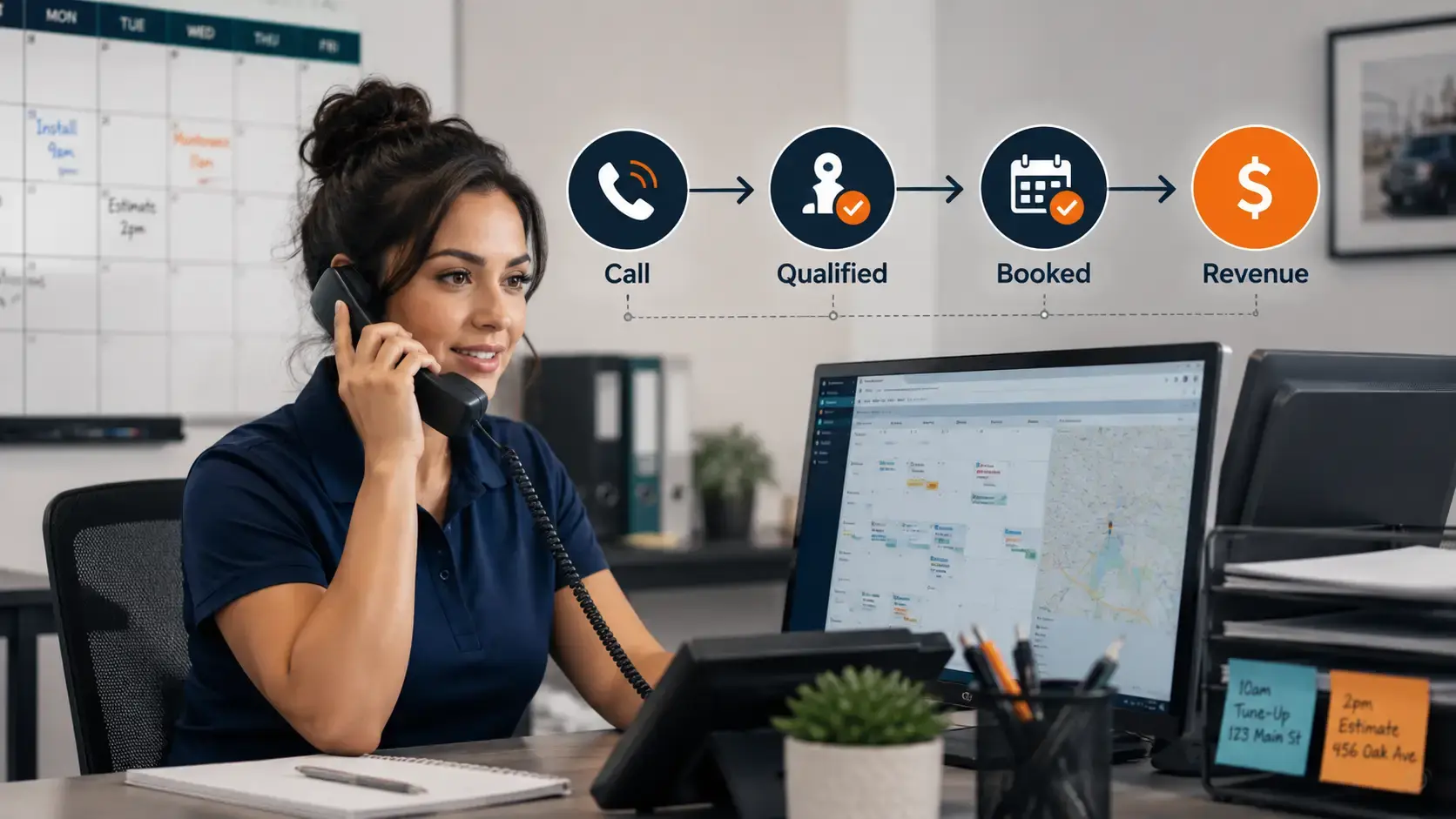
Once an HVAC prospect calls, submits a form, or reaches out online, the business still has to:
- Identify where the lead came from
- Answer or recover the inquiry
- Qualify the opportunity
- Book a clear next step
- Track the lead in one place
- Follow up if it does not close immediately
- Record the final outcome
- Connect that outcome back to marketing
If those steps are inconsistent, more marketing can simply create more opportunities to lose leads.
The goal is not a complicated tech stack. It is a simple, repeatable HVAC lead-handling process that turns inquiries into trackable opportunities and, when things go well, booked work.
The Phone Call Is Not the Finish Line
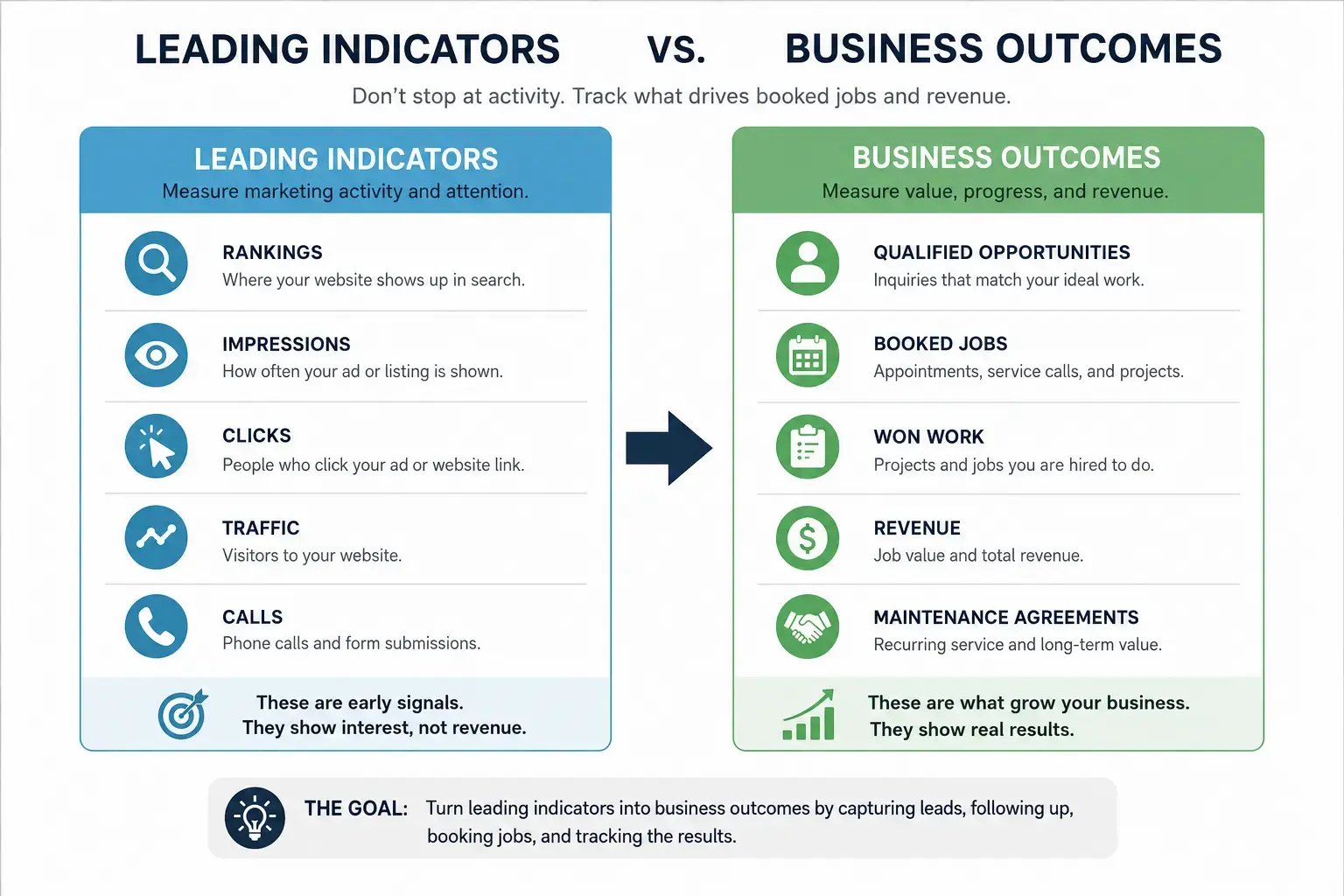
For HVAC companies, rankings, traffic, clicks, ads, and phone calls can all look like progress.
But they are still leading indicators.
A phone call is not revenue.
A form submission is not a booked job.
A Google Ads lead is not automatically a good customer.
The real work begins after the prospect reaches out.
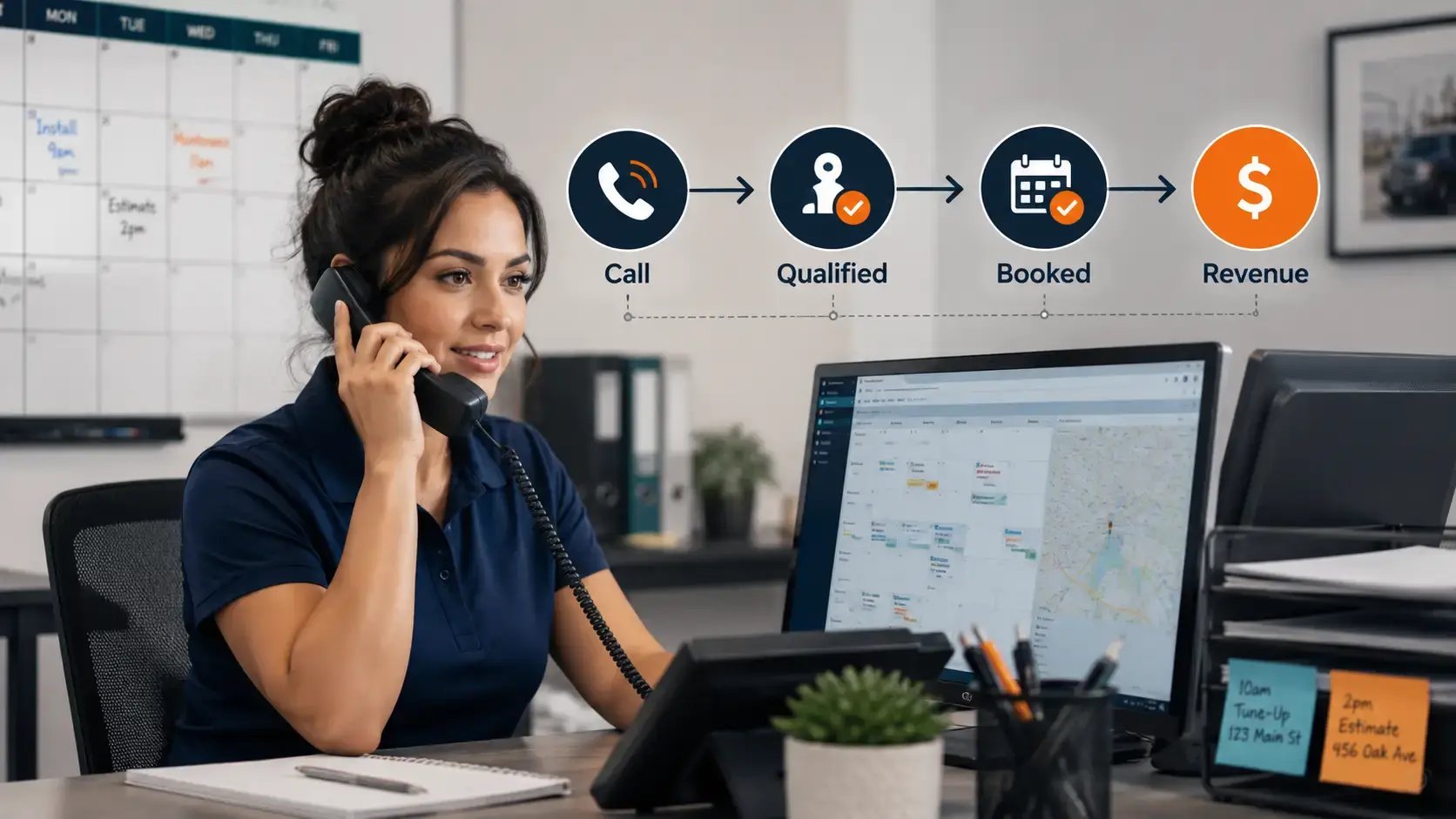
A lead has to be captured, handled, qualified, routed, booked, tracked, followed up with, and eventually tied to an outcome.
That is where many otherwise solid marketing programs become hard to evaluate.
If the company knows that 30 calls came in but cannot tell which became qualified opportunities, booked jobs, estimates, or revenue, the marketing report stops too early.
Step 1: Identify Where the Lead Came From
When someone contacts your company, the first question from a marketing standpoint is simple:
Where did this inquiry come from?
That does not mean the dispatcher needs to become a data analyst.
It means the business should have a reasonable way to distinguish major lead sources so it can see which channels produce useful opportunities.
Common lead sources include:
- Google Business Profile and Google Maps
- Organic Google search
- Google Ads
- Local Services Ads
- Referrals
- Facebook or other social media
- Email campaigns
- Direct website traffic
- Other offline or partner sources
Call Tracking, in Plain English
Call tracking uses different phone numbers for different marketing sources.
Those numbers route to your normal business line, while the system records which source generated the call.
The customer still reaches your company. The tracking layer simply gives you better attribution.
For website forms, source information can often be captured using UTM parameters or analytics data.
A UTM is just a small label added to a link so the system can recognize that a visitor came from a specific campaign, ad, email, or source.
The purpose is not to build a beautiful dashboard.
It is to answer a more useful question:
Which marketing sources are producing qualified opportunities and, eventually, revenue?
Step 2: Answer the Call — or Recover It Fast
The best tracking system in the world does not help if a valuable inbound call rings out and nobody owns the follow-up.
HVAC businesses should define what happens during:
- Normal business hours
- After hours
- Lunch coverage
- Weekends
- High-volume periods
- Times when the office is overloaded
The process does not have to be elaborate, but it should be deliberate.
At a minimum, the company should know:
- Who is responsible for answering during normal business hours?
- Where do calls go if the primary person cannot answer?
- What happens after hours?
- Does voicemail create a task for someone to call back?
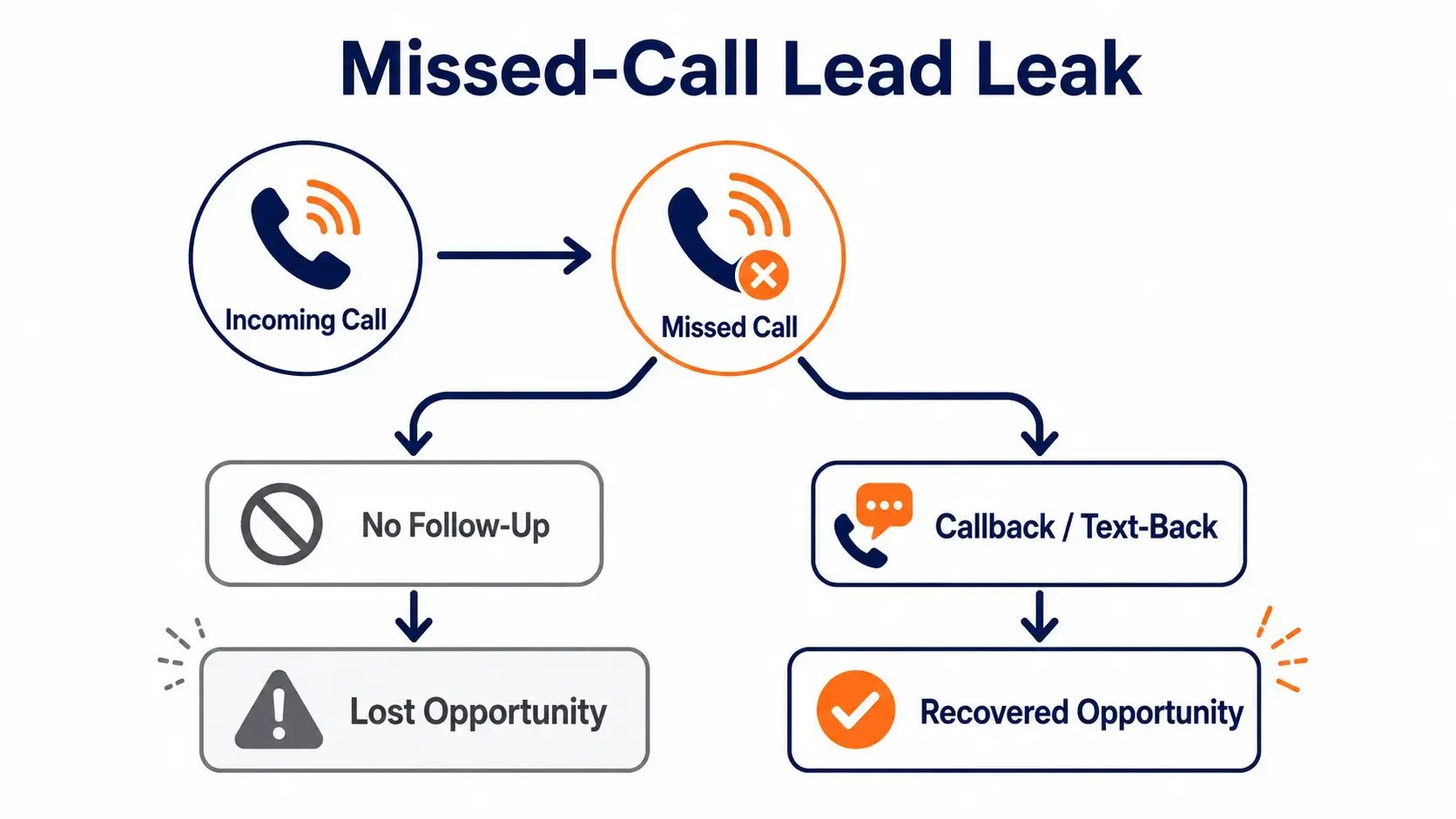
- Can a missed-call text-back help acknowledge the inquiry?
- Who owns the callback?
- How is that follow-up marked complete?
A missed call should become a visible follow-up item.
It should not disappear into a phone log that nobody checks.
The same principle applies to website forms and chat inquiries.
Step 3: Qualify the Opportunity
Qualification is not about interrogating the caller.
It is about collecting enough information to understand what they need and what should happen next.
For a typical HVAC inquiry, the person handling the lead may need:
- Caller name
- Company or property name, when applicable
- Service address
- Residential or commercial
- Type of problem or requested service
- Urgency
- System or equipment type, if relevant
- Whether they are an existing customer
- How they heard about the company
For commercial HVAC, a little more context may help.
Useful information can include:
- Property type
- Number of locations
- System or equipment involved
- Emergency vs. planned work
- Caller’s role in the decision
- Whether there is an existing maintenance agreement
The point is to make the next step easier.
If your team routinely collects information that nobody uses, simplify the intake.

Step 4: Book the Next Action
Every legitimate lead should leave the first interaction with a defined next step.
That might mean:
- Dispatch a technician
- Schedule a service call
- Schedule an estimate
- Arrange a site visit
- Send requested information
- Route the inquiry to the commercial service team
- Schedule a sales or project conversation
The most important part is ownership.
Someone should know:
- What happens next
- When it should happen
- Who is responsible
A vague status such as:
“They might call us back.”
is difficult to manage.
A better status is:
“Follow up Tuesday after the property manager review.”
with an assigned owner.
Step 5: Put the Lead Somewhere Trackable
Sticky notes, personal inboxes, memory, and disconnected spreadsheets can work for a very small operation.
They become risky as lead volume and staff grow.
The solution does not have to be an expensive CRM.
Many HVAC companies already use field-service or customer-management software that can handle much of this.
Others may use a simple CRM or a disciplined shared tracker.
A basic pipeline can be enough:
New Inquiry → Contacted → Qualified → Booked → Estimate / Opportunity → Won / Lost
The exact stage names matter less than consistency.
If one dispatcher uses “open,” another uses “pending,” and a salesperson keeps opportunities in email, reporting becomes unreliable.

Step 6: Follow Up When the Lead Does Not Book Immediately
Not every qualified inquiry will book on the first contact.
That does not automatically make it a dead lead.
A prospect may:
- Need approval
- Be collecting multiple estimates
- Be waiting for a decision-maker
- Be coordinating with a property manager
- Simply be busy
- Not be ready yet
Commercial opportunities can involve several people and a longer decision process.
Reasonable follow-up might use:
- Phone
- Text
The goal is to create a consistent process without turning follow-up into spam.
For example, an estimate or unbooked opportunity could receive:
- A scheduled follow-up task
- A second attempt if the customer does not respond
- A final status if the opportunity is genuinely lost
The cadence should fit the type of job and the way your customers buy.
The same principle applies to estimates:
Sent should not mean forgotten.
Step 7: Track the Job Outcome
Marketing reporting becomes much more useful when it continues past the initial lead.
Where practical, track:
- Qualified opportunities
- Booked jobs or appointments
- Estimates or proposals
- Won work
- Lost work
- Lost reason, when useful
- Job value or revenue where available
- Maintenance agreements
- Recurring service relationships
Leading Indicators vs. Business Outcomes
Leading indicators:
- Impressions
- Rankings
- Clicks
- Traffic
- Calls
- Forms
Business outcomes:
- Qualified opportunities
- Booked jobs
- Won work
- Revenue
- Maintenance agreements
Leading indicators tell you whether marketing is creating attention.
Business outcomes tell you whether that attention is becoming useful work.
Step 8: Close the Loop Back to Marketing
Once lead source and job outcome live in the same reporting process, the business can start making better marketing decisions.
Consider this hypothetical example:
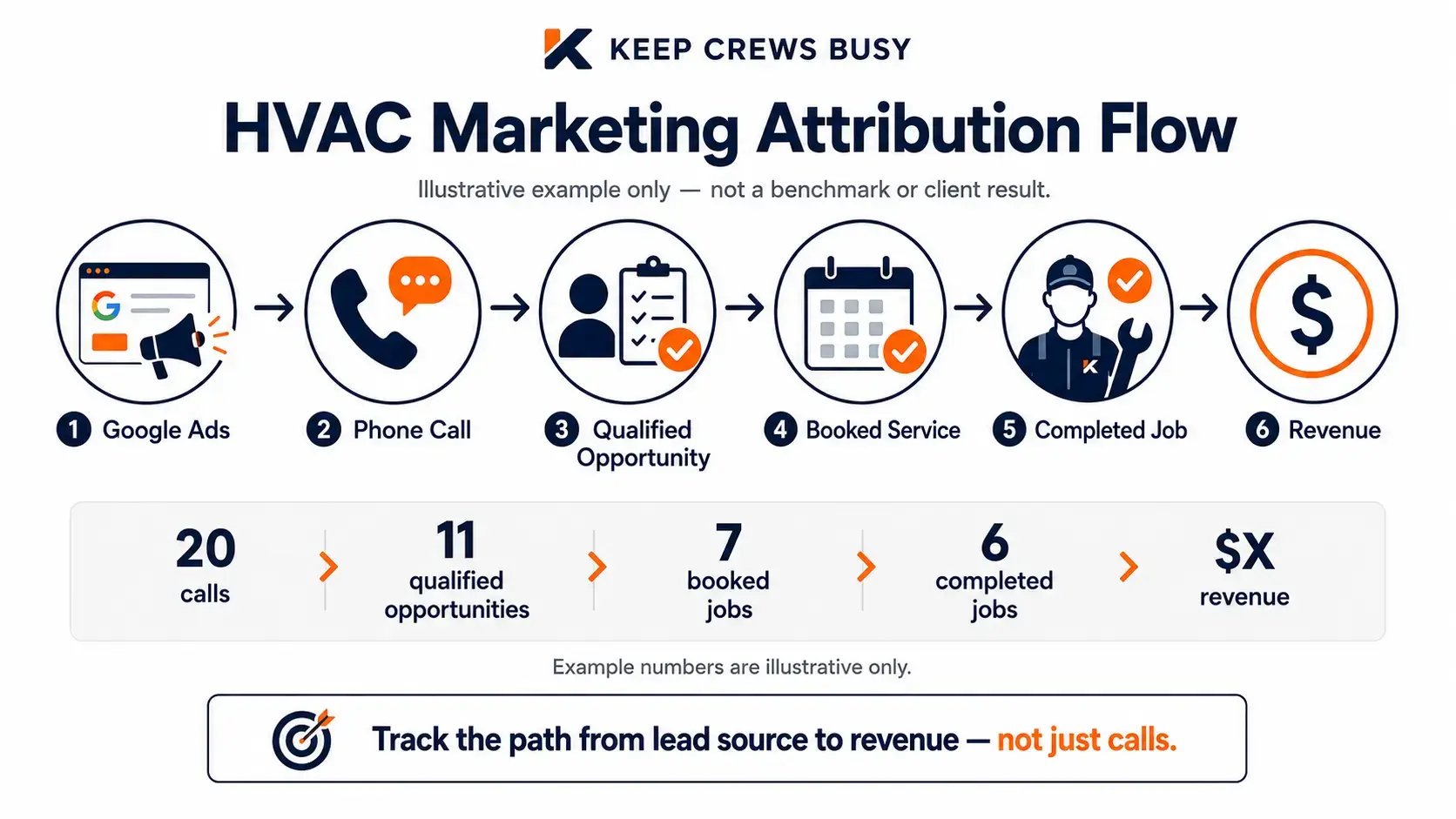
“Google Ads generated 20 calls.”
That is useful.
But this is much more useful:
“Google Ads generated 20 calls, 11 qualified opportunities, 7 booked jobs, and $X in revenue.”
Those numbers are illustrative only. They are not a benchmark or real client result.
That kind of information can reveal very different problems.
A channel might generate plenty of calls but very few qualified opportunities.
Another might produce fewer leads but stronger jobs.
A campaign could be working while the office is losing calls.
Or the leads may be fine while estimates are not being followed up.
Without closing the loop, all of those situations can look like a generic “marketing problem.”
Common HVAC Lead Leaks
You do not need a sophisticated audit to find the first few problems.
Look for obvious breaks in ownership and tracking.
Common leaks include:
- Missed calls with no recovery process
- Slow or unclear response ownership
- Web forms going to the wrong inbox
- No call tracking
- Lead source never captured
- No simple qualification process
- No follow-up after the first contact
- Estimates sent and forgotten
- No shared CRM, pipeline, or lead tracker
- Marketing leads never connected to booked jobs or revenue
A company can have strong SEO and ads and still lose money in these handoffs.
Fixing the handoff may be more valuable than immediately buying more traffic.
A Simple HVAC Lead-Handling Workflow
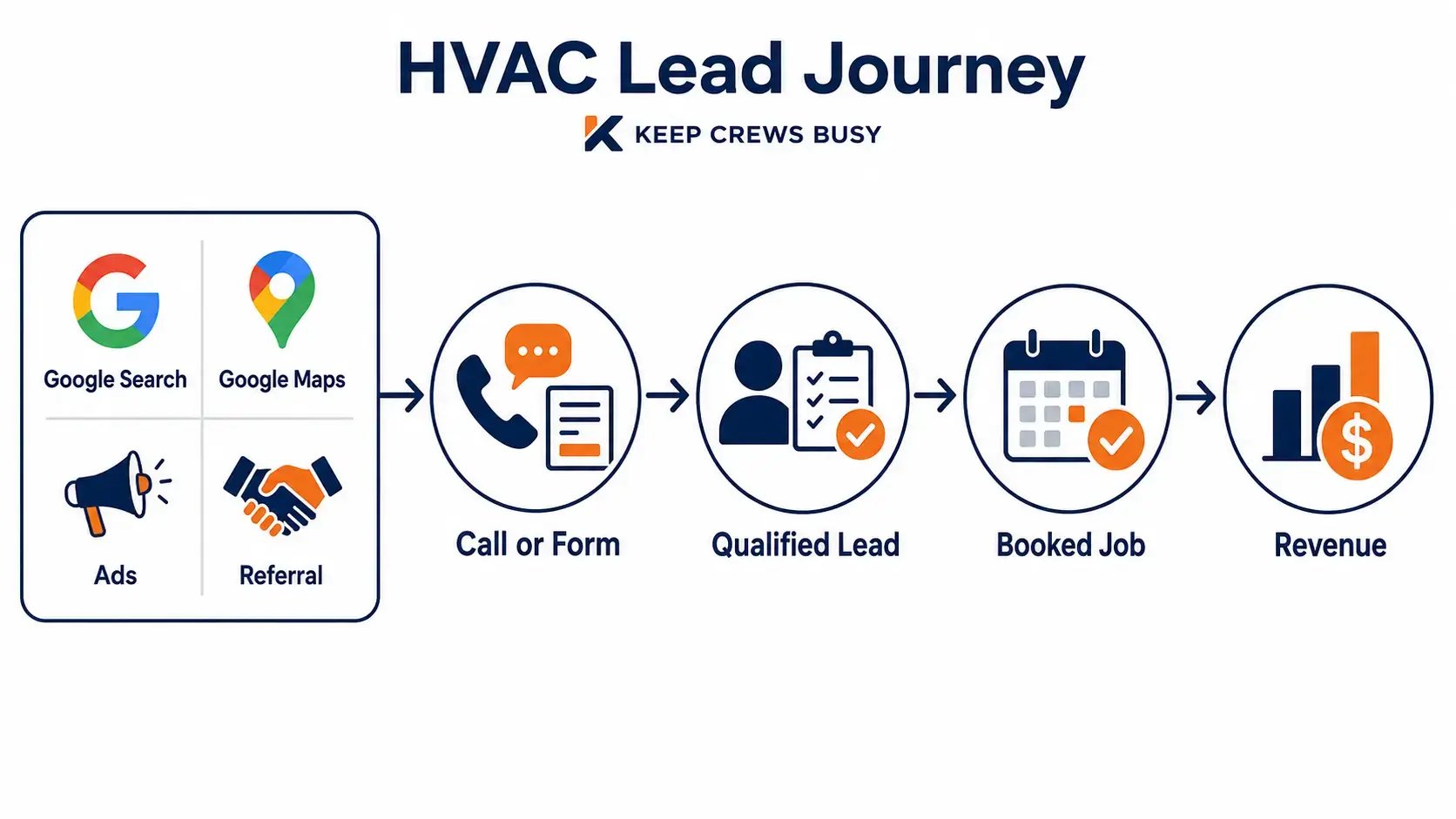
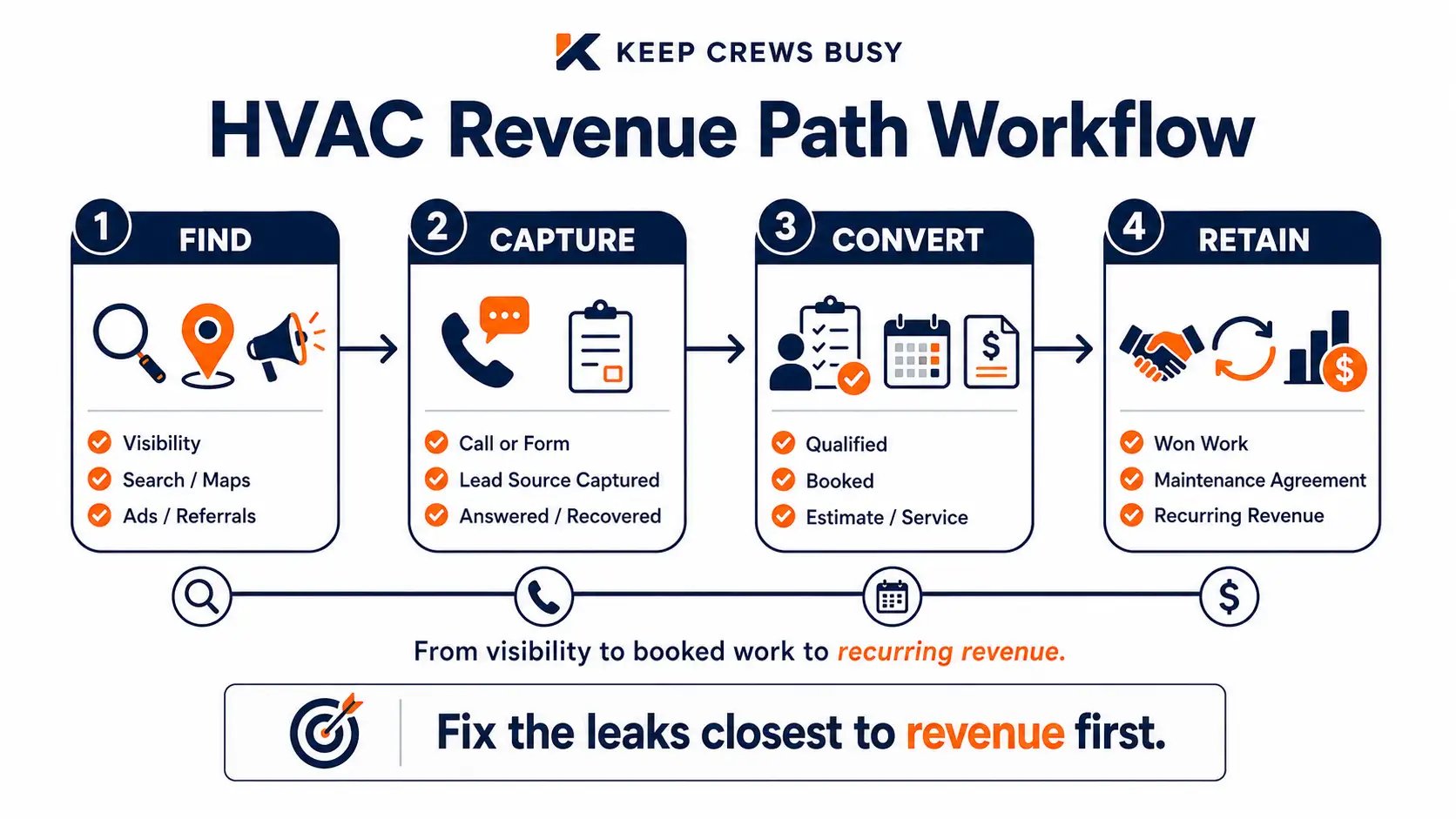
Here is a simple version of what the process can look like:
Search / Ad / Referral
↓
Call or Form
↓
Lead Source Captured
↓
Answered or Recovered
↓
Qualified
↓
Booked
↓
Tracked in CRM
↓
Estimate / Service
↓
Won or Lost
↓
Revenue / Outcome Recorded
Search, ads, referrals, email, and other channels create the inquiry.
The call or form is captured.
The team records the source, answers or recovers the contact, qualifies it, and books the next step.
From there, the opportunity stays visible in a shared system until it reaches an outcome.
That final outcome is then tied back to the original source where practical.
A Simple HVAC Lead Audit You Can Run This Week
Pick a recent sample of calls, forms, and estimates and walk through the process from beginning to end.
You are looking for breaks, not perfection.
Use this checklist:
- Are inbound calls answered consistently?
- Does every missed call create a visible follow-up task?
- Do after-hours inquiries have a defined response path?
- Do website forms reach the right person?
- Is the marketing source captured for most meaningful inquiries?
- Does the person handling the lead collect the information needed for the next step?
- Is every qualified opportunity assigned to an owner?
- Does every real opportunity have a defined next action?
- Are unbooked inquiries followed up?
- Are estimates tracked after they are sent?
- Can the team distinguish won work from lost work?
- Can you see which marketing channels create qualified opportunities?
- Can you see which channels create booked jobs?
- Can you connect at least some marketing activity to revenue?
- For commercial HVAC, are maintenance agreement and renewal opportunities visible after the initial job?
If several of those answers are “no,” that gives you a practical place to start.
More Leads Do Not Automatically Mean More Revenue
There is a natural instinct to solve a slow pipeline by buying more traffic, increasing ad spend, publishing more content, or trying another lead source.
Sometimes that is exactly what the business needs.
But before aggressively adding more leads, make sure the current process can reliably capture the opportunities already coming in.
The strongest lead-handling systems are usually not the most complicated.
They simply make ownership, next steps, follow-up, and outcomes visible.
That gives the company a cleaner way to improve operations and a much clearer way to judge whether its marketing is actually working.
Keep Crews Busy helps HVAC companies identify where leads and revenue may be slipping through the cracks — from visibility and call handling to estimate follow-up, tracking, and recurring revenue.
No hype. No fake guarantees.
Fix the leaks closest to revenue first.